
The German Shepherd: America's living-room satellite
October 22, 2026
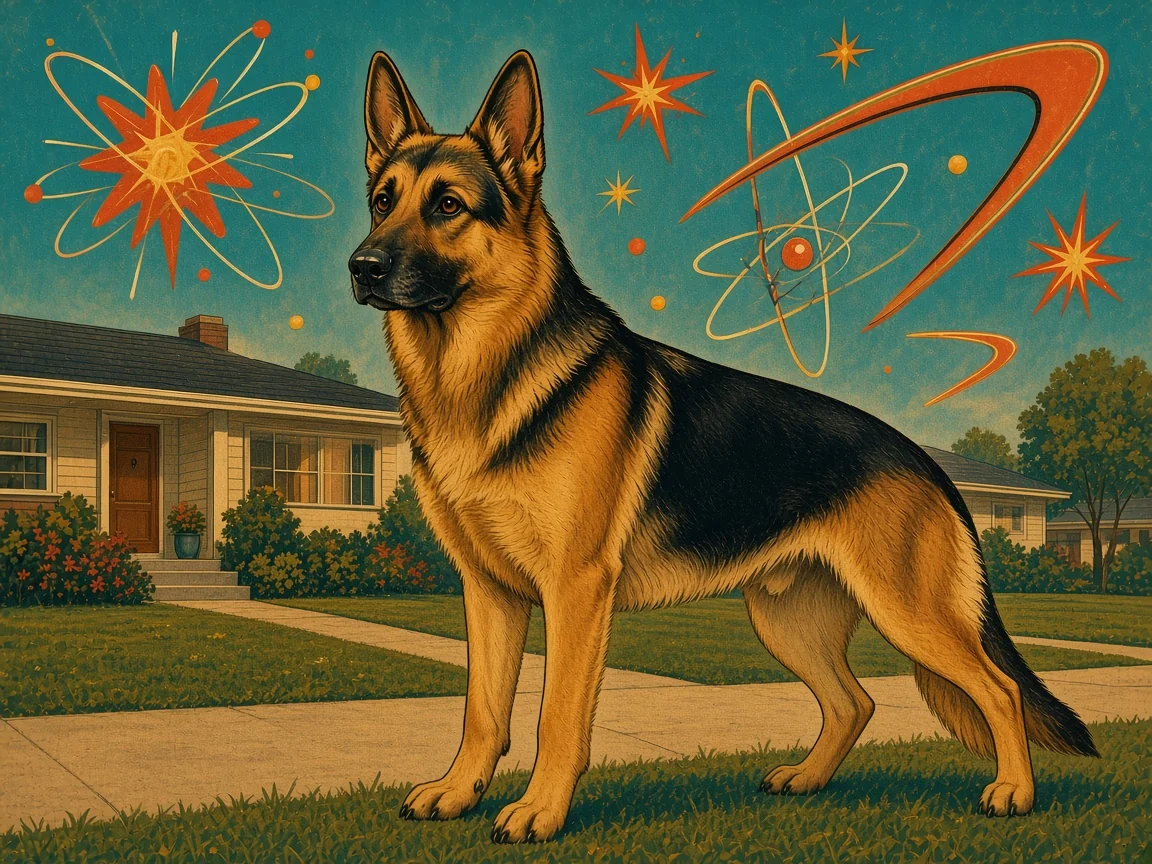
America’s living-room satellite — noble silhouette, ranch-house watch.
Ladies and gentlemen of the living room — and you, Sir, adjusting the rabbit ears — we interrupt this evening’s broadcast for a public-service announcement of the highest order.
There is a new kind of satellite in the American home. It does not beep from orbit. It does not require a dish on the roof. It lies, alert and gleaming, on the cream carpet between the television console and the coffee table, listening to the neighborhood the way a newsreel listens to history. Its coat is black and tan. Its ears are upright as antennae. Its name, spoken with the confidence of a brand that has already won the war for the backyard, is the German Shepherd.
We present the Shepherd not as a novelty, and certainly not as a cartoon. We present it as mid-century America already understood it: a working mind in a family frame — police partner, military courier of loyalty, and the quiet sentinel who decides, each evening, whether the doorbell is friend or weather.
Breed dossier
Before the Shepherd was a living-room fixture, it was a purpose. In the late nineteenth century, German sheep-herding dogs were valued for stamina, nerve, and flock work. Captain Max von Stephanitz wanted that utility standardized: one breed, function first. In 1899 he founded the Verein für Deutsche Schäferhunde (the SV), and the German Shepherd Dog entered the record books on a blunt charter — a dog that could not work was unfinished.
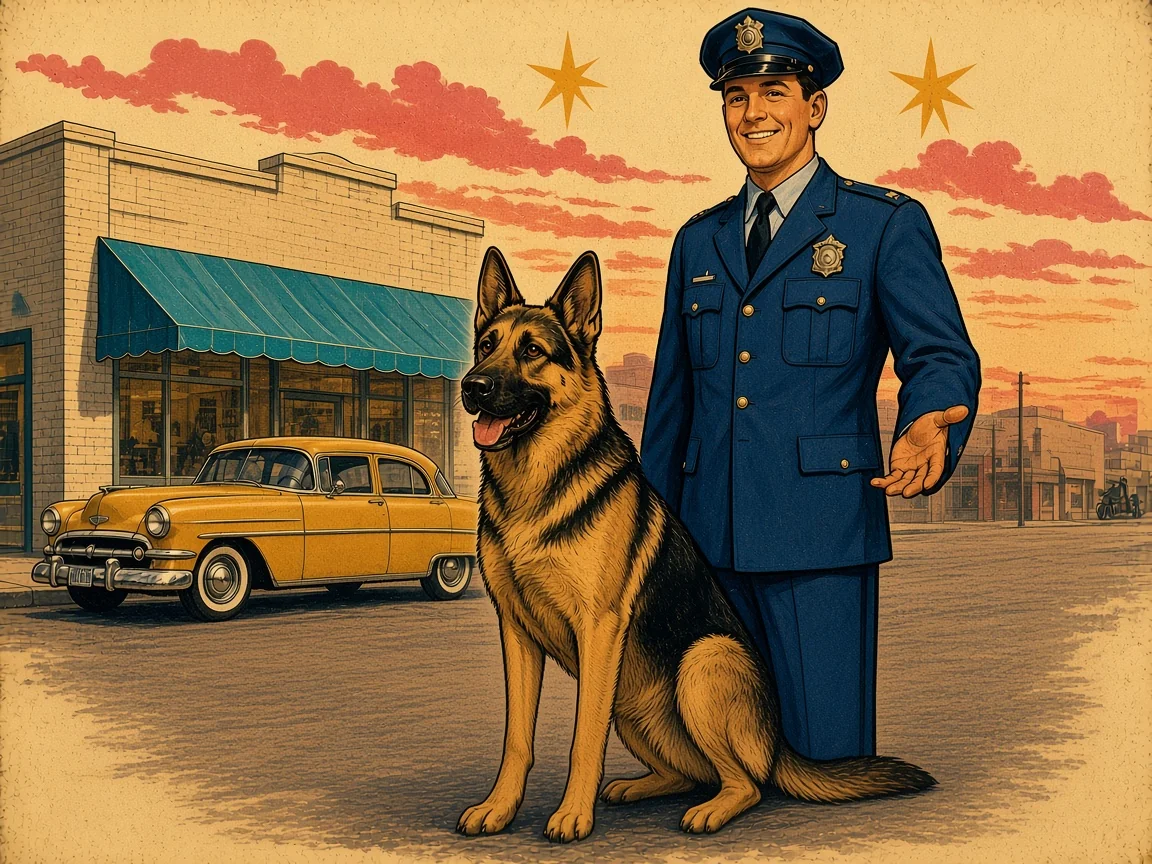
Working charter in uniform — police partner, civic nerve, public trust.
That charter traveled. Trainability, scenting ability, and composure under pressure made the breed valuable beyond the farm: police partner, military service dog, guide for the blind, household guardian. America met the Shepherd in uniforms, on newsreels, and on theater screens — most famously through Rin Tin Tin, who sold the public on the noble silhouette and on loyalty under assignment. We will not romanticize conflict. The civilian translation is simpler: reliability with a job. Bring the assignment indoors and you have a family dog. Leave it blank and you have a talented underemployed executive chewing the baseboards.
Blueprint. Substantial, athletic frame built for distance and slope; longer than tall; double coat that sheds in earnest (classically black-and-tan or sable). Erect ears, dark attentive eyes, enduring gait from the herding inheritance. Watch the dog move — the brochure is not the road test. Males run larger; females are often lighter and just as capable. Neither is a lap ornament.
Temperament. At its best: intelligent, highly trainable, bonded hard to its people, reserved with strangers until the house rules are clear, steady when properly socialized, and driven toward purpose. Reserve is a feature, not a defect — a noisy bluff is a different product line. Early socialization is the wiring diagram, not optional decoration: people, sounds, surfaces, and other dogs while young. The breed rewards confident, consistent handlers and bores easily of wishy-washy ones. With family, expect deep attachment and a dog that shadows the evening routine; with strangers, expect politeness that must be taught. Fearfulness dressed up as “protection” is not the product — confidence assesses; fear reacts.
Working roles (short form). Herding echoes remain (circling, edge-watching — channel them; do not merely scold the history). Police and military service made the silhouette famous; civilians need the same hardware pointed at obedience, scent games, hiking, and structured fetch. Service and sport lineages prove the partnership capacity. The role most households actually buy is quiet guardian: early warning without sidewalk diplomacy incidents. Training and management decide which ending you get.
When the herding brain needs a legal quarry after dinner, a scent puzzle beats a lecture. The Outward Hound Hide-A-Squirrel turns the living room into a small, squeaky crime scene — nose work with a clear end condition, and a Shepherd who looked unemployed five minutes ago suddenly has paperwork.
Owner’s manual
Consider this your appliance booklet — serious type, adult assumptions.
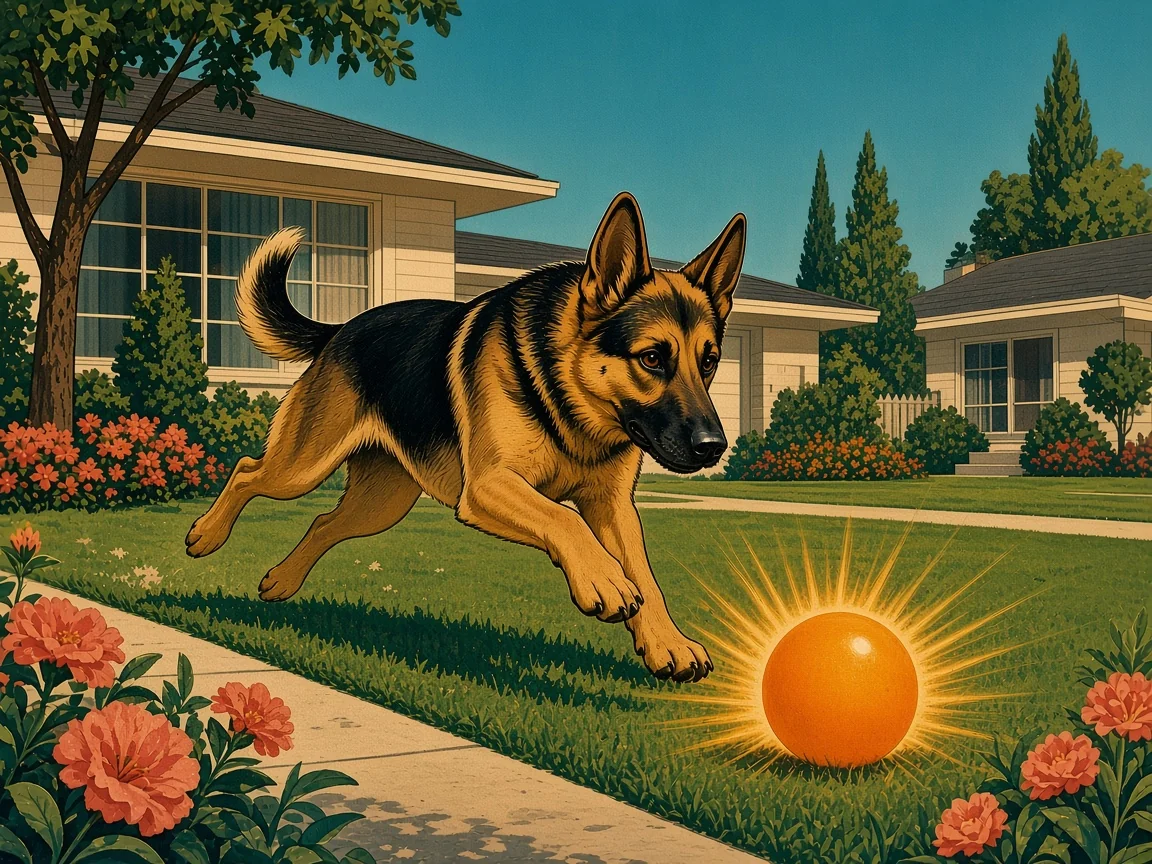
Sortie on the lawn — body and brain, fetch with intent.
Exercise. Daily work that raises the heart rate: purposeful walks, real fetch, hiking when you can. Body and brain — twenty minutes of focused training or a simple scent game often buys more quiet than an hour of aimless circling. A bored Shepherd is a renovation you did not approve. For the lawn sortie, the Chuckit Ultra Ball is the glowing orange quarry that keeps the sortie honest — distance, bounce, and a job with a clear end condition.
Training and walks. Clear cues, fair timing, sessions short and ended on success. Obedience is the native language; tricks are welcome overtime. Harsh theatrics backfire. The Shepherd reads your mood like a barometer. For strong opinions on the leash, fit a padded everyday harness with a front clip option — hardware pointed at redirect, not at the collar as a debate stage.
Grooming and home. Brush regularly; budget vacuum time. The double coat is not a rumor — short sessions with an undercoat tool beat heroic Saturday projects. Bathe as needed. After the yard tour, the Dexas MudBuster is the modern miracle for four muddy instruments and one cream carpet that preferred to stay cream. A fenced yard helps; an apartment works only if walks and enrichment are ruthless.
Crate training, kindly done, gives a den — not exile. A roomy double-door crate with a divider for the growing years is ranch-house realism: settle, rest, resume the evening broadcast. Teach settle. Teach that the doorbell is information, not a starting gun.
Food, growth, health. Feed an athlete, not a cushion — extra pounds tax hips. Joint-aware exercise while growing; no heroic jump programs for puppies. Ask about health testing (hips, elbows, and line concerns). Buy from responsible sources; budget for care. The first year is charming and exhausting — invest in socialization early or pay later.
Period props for a breed with a mission

Mission kit — eye protection for weather, enrichment for the evening ledger.
Three classic field specimens where a Shepherd’s real needs live — exercise, working mind, outdoor weather — plus the harness, undercoat tool, and den on the requisition slip above. No live prices; inspect the product page or requisition on Amazon when you are ready.
1. For the lungs that still want a sortie.
2. For the mind that files paperwork after dinner.
The freezer is not only for TV dinners. A stuffed, frozen KONG Classic turns evening energy into a quiet assignment. Supervise. No toy is indestructible; a Shepherd will test the claim. On nights when you want a refillable cold case instead of a rubber cave, the Woof Pupsicle keeps the same postwar prosperity: long licks, quieter house, bridge club uninterrupted — usually.
3. For the eyes on wind, grit, and the open road.
Three specimens. Three jobs. That is the whole commercial — plus the requisition slip above when you are ready to kit the household satellite properly.
Soft close — join the pack
The German Shepherd is not a lifestyle accessory. It is a partnership with a timetable: exercise, training, grooming, socialization, and a mission that renews each morning — the same usefulness charter written in 1899, translated for the ranch-house porch. If that sounds like the right work for your household, you already know. If not, thank the breed for its honesty and choose a quieter satellite.
Want the next breed spotlight, the odd useful find, and soft alerts when we open a new field kit — without the hard sell? Get on the Ruff Budget list when the newsletter launches. Same living room. Better reception. Until then, inspect a specimen, requisition what fits your mission, and keep the antennae pointed at useful work.
If you buy through this link we may earn a commission, at no extra cost to you. As an Amazon Associate I earn from qualifying purchases. Disclosure